


























A sedan tyre in the UAE has a hard job for a car that looks easy on tyres. Daily commutes mix stop-start traffic in Deira or Al Nahda with long 120 km/h stretches to Abu Dhabi, the road surface reaches 60 to 70°C in July and August, and taxis and ride-hailing cars can cover 60,000 km a year. A touring tyre with a heat-resistant compound and a quiet, asymmetric tread is the right default for most owners.
We fit sedan tyres at your home, office or parking bay. The technician removes the old tyres, mounts and balances the new set on the van, torques the wheel nuts to spec and sets pressure to your door placard, usually in under an hour for four tyres.
Choosing a touring tyre for UAE heat
A touring tyre with a UTQG temperature grade of A and a silica-rich summer compound is the safest choice for a UAE sedan. Grade A means the tyre passed the highest heat-dissipation test at speed, which matters when the car spends hours on asphalt hotter than 60°C.
All-season tyres sold in Europe are designed for cold, wet winters and wear faster here. Ultra-high-performance tyres grip well but often last 30,000 to 40,000 km, against 60,000 km or more for a good touring tyre. For a commuter car, touring wins.
- Look for temperature grade A and traction grade A or AA on the sidewall
- Treadwear 500 or higher suits taxis and long commutes
- Keep the original speed rating or go higher, never lower
Premium, mid-range or budget for a sedan
A premium 215/55 R17 tyre typically costs AED 450 to 700 fitted in the UAE, a mid-range one AED 300 to 450, and a budget one AED 200 to 300. The gap shows up in wet braking, noise at 120 km/h and how evenly the tread wears over 50,000 km.
For a car that does mostly city driving and is replaced every three or four years, a good mid-range tyre such as Hankook or Kumho is sensible value. For a family car that does regular Dubai to Abu Dhabi runs, a premium touring tyre pays for itself in comfort and stopping distance.
Why sedan tyres wear unevenly
Front-wheel-drive sedans wear their front tyres roughly twice as fast as the rears, because the front axle steers, brakes and drives. Rotating front to rear every 10,000 km evens this out and lets you replace all four together.
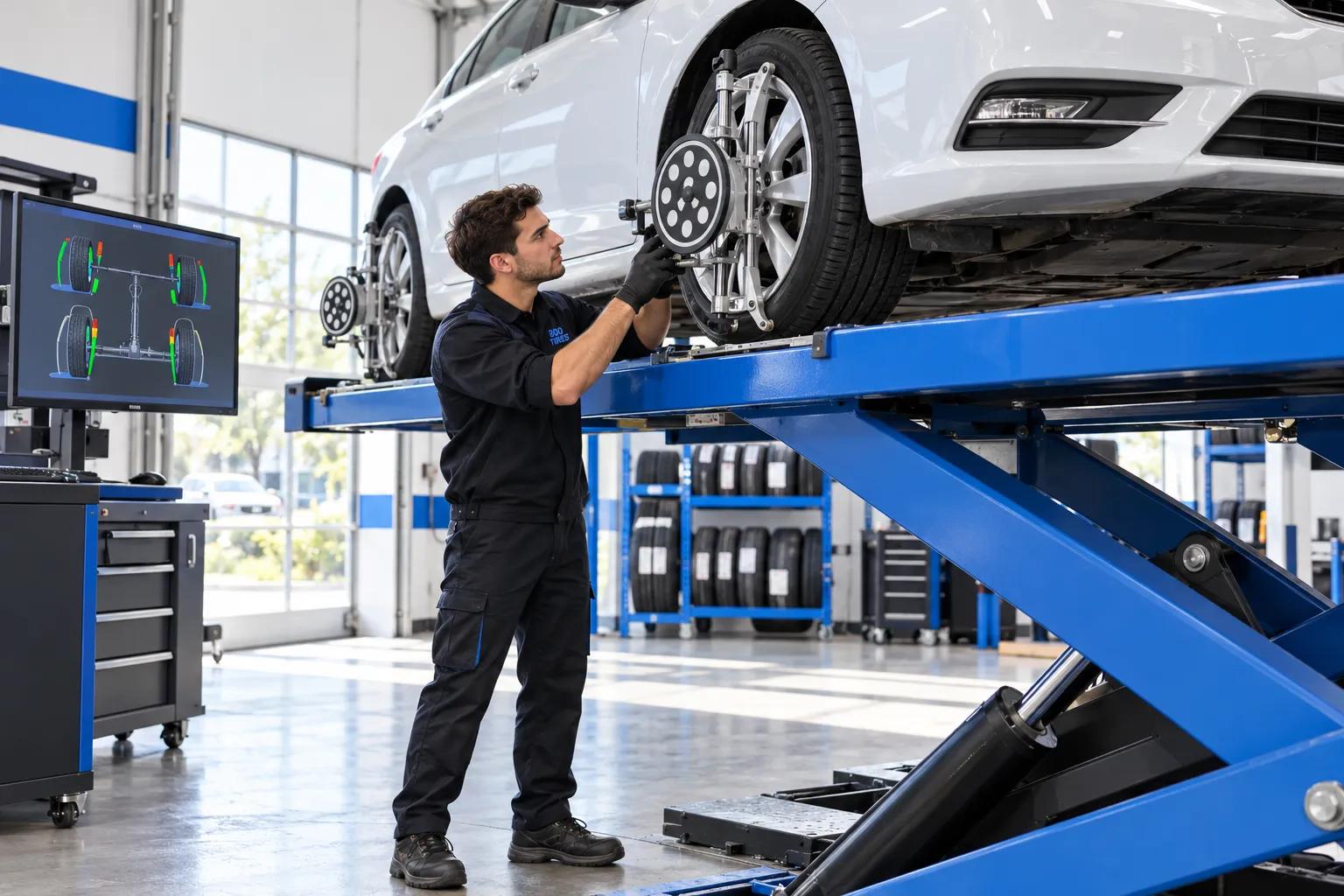
Inner-edge wear on the front tyres usually points to toe or camber out of spec, often after hitting a kerb or a deep speed bump in a villa community. Feathered edges, a pull to one side or an off-centre steering wheel are signs to book a wheel alignment before fitting new tyres.
Taxi, fleet and ride-hailing sedans
A sedan covering 5,000 km a month can wear through a set of touring tyres in under a year, so treadwear rating and puncture resistance matter more than outright grip. Drivers in this category usually get the best cost per kilometre from a mid-range or premium tyre with a UTQG treadwear of 600 or more.
Fleet cars also spend more time parked in open sun, which ages rubber faster. Check the DOT date when buying, and check pressure weekly, since a tyre running 5 PSI low wears its shoulders and burns more fuel.
Technician tips
- Check pressure every two weeks in summer, cold, against the door placard.
- Rotate front to rear every 10,000 km on front-wheel-drive sedans.
- Replace at 3 mm of tread for UAE summer rain and sand, not at the 1.6 mm legal limit.
- Fit new tyres on the rear axle if you only buy two; the rear holds the car stable under braking.
- Avoid climbing kerbs in mall car parks; one hard hit can bend a rim or cut a sidewall.
- Ask for the DOT date before fitting; a tyre made in the last 12 months is ideal.